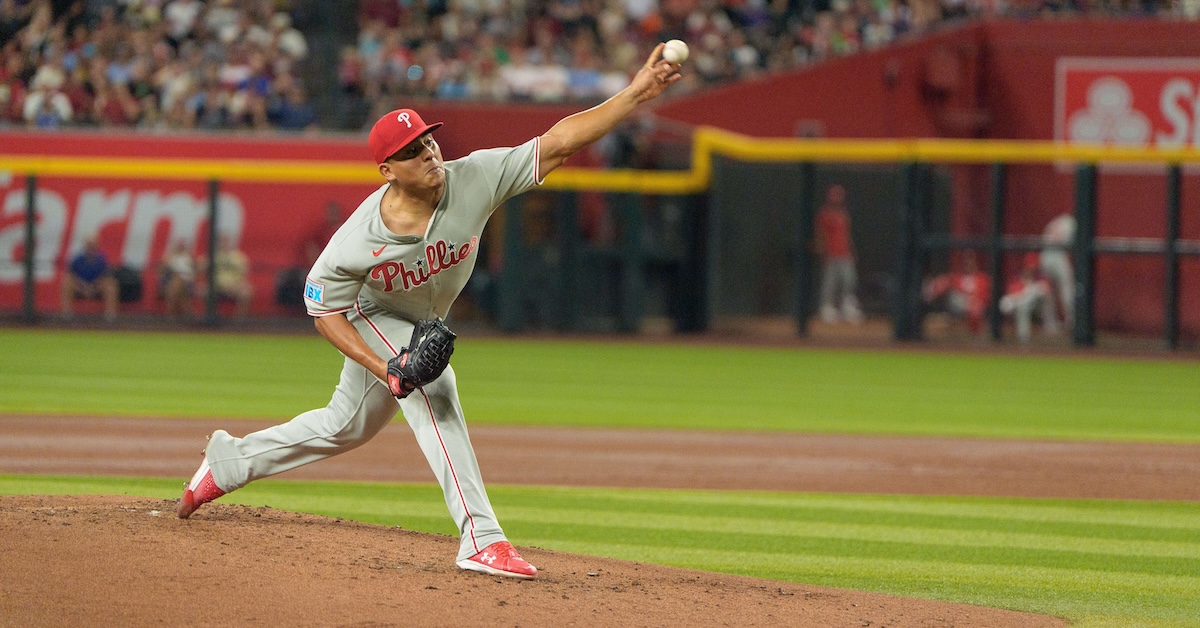
The Red Sox have finally done it. On Wednesday afternoon, the Sox became the last team in baseball to agree to terms with a major league free agent and they did so with a bang, nabbing southpaw Ranger Suárez on a five-year deal worth $130 million. Jon Heyman of the New York Post first reported the signing, while Bob Nightengale of USA Today reported the terms. Alex Speier of the Boston Globe reported that the deal contained no deferred money, meaning that the average annual value is a straight $26 million. Setting aside Alex Bregman’s opt-out laden pillow contract and several two-year deals given to pitchers who missed the first while recovering from injuries, this represents the first true multi-year commitment the team has made to a free agent during the tenure of chief baseball officer Craig Breslow. The Red Sox are finally going for it using every means available, and with one of the game’s most consistently good (if not consistently available) starting pitchers on their roster, they are looking more and more like a championship contender.
The Red Sox went into the offseason with one of the game’s greatest starters in Garrett Crochet, but there was a big gap between him and the rest of the rotation, which featured a number of solid pitchers who hadn’t managed to step up and grab the no. 2 spot in Brayan Bello, Tanner Houck, and Kutter Crawford. Boston upgraded through trades for Sonny Gray and Johan Oviedo, and according to our depth charts, they projected to have the best rotation in the game even before signing Suárez (the Phillies, even without Suárez, rank fourth).
Still, this is a different caliber of move, the effects of which seem likely to cascade down the roster. It represents a major commitment in both years and dollars, and according to RosterResource, it pushes Boston just over the second luxury tax threshold. All of a sudden, Bello and Co. are likely jockeying for the fourth or fifth spot in the rotation rather than the second. The Red Sox also boast Patrick Sandoval, who missed the 2025 season recovering from internal brace surgery, and Kyle Harrison, who came over in the Rafael Devers trade and projects for an above-average line in 2026. We’ve now named nine different viable big league starters, before you even get to coveted prospects like Payton Tolle and Connelly Early, who debuted in 2025. That’s a lot of depth to deal from, freeing Boston up to trade a starter and maybe some of its outfield surplus to reinforce a particularly weak infield.
The Red Sox turned to the starting pitching market after failing to bring Bregman back, and it’s at least possible that signing Suárez will allow them to trade for Nico Hoerner or Matt Shaw, who would only be on the market because Bregman might have made them superfluous in Chicago. The dominos could fall the other direction too. Losing Suárez could make the Phillies even more desperate for Bo Bichette, and should they sign him, it’s not hard to foresee them trading Bryson Stott or Alec Bohm to Boston in order to replenish their rotation depth. Lastly, the Red Sox have been linked to Bichette themselves, and it’s at least possible that, already in luxury tax territory for a penny, they decide to go in for a pound and sign him too.
As for Suárez, this must be an incredibly validating day. He was a relatively unheralded prospect out of Venezuela; the Phillies signed him for just $25,000 in 2012. He overcame injuries, fought his way into one of the best starting rotations in the game, and pitched brilliantly whenever he got the chance. He’s excelled in the playoffs, where he owns a 4-1 record with a 1.48 ERA and 3.02 FIP over eight starts and 11 appearances. Despite all that success, inconsistent playing time held down Suárez’s salaries in arbitration. He rejected the qualifying offer after making just $8.8 million in 2025 despite putting up $32.3 million in value based on some rough dollars-per-WAR calculations. For the first time ever, he’s about to be paid what he’s worth.
Since 2022, Suárez’s first season as a full-time starter, he’s run a 3.59 ERA and 3.57 FIP over 104 starts. He’s made his mark despite a series of minor injuries – an elbow strain, a hamstring strain, and recurring back issues – that kept him from ever reaching 30 starts in a season. He’s ranked 33rd in innings pitched over that period, and his 12.2 WAR rank 19th among all pitchers, right between Chris Sale and former teammate Jesús Luzardo. He ranks down toward the very bottom of the game in terms of velocity, so Suárez leads with his sinker, but he doesn’t lean on it. He throws six pitches, five of them at least 15% of the time. Although he regularly clocks 20th-percentile whiff rates, world-class command allows him to both avoid walks and strike out batters at a league-average rate. It also allows him to induce some of the weakest contact in the league while running excellent groundball rates.
Back in June, Michael Rosen tried to figure Suárez out in a piece titled “How Much Would You Pay Ranger Suárez?” He expressed his concerns while noting the various ways Suárez has succeeded to this point in his career. Suárez’s pitches tunnel exceptionally well according to Baseball Prospectus’ new pitch arsenal metrics, and the movement profiles of his sinker and cutter mirror each other, keeping hitters off balance and inducing weak contact. In recent years, as Suárez’s fastball velocity has dropped, his changeup velocity has dropped even further, and that bigger gap has paid dividends. Still, whether Suárez can succeed with even less velocity into his mid-30s is an open question. How slow can his cutter get before hitters are able to time it even after waiting to tell it apart from his sinker? How slow can his loopy curveball get before hitters have time to recover from their initial surprise when he drops it into the strike zone?
Suárez took the ninth spot on our Top 50 Free Agents list, and Ben Clemens nailed the contract terms exactly. The crowdsourced projection was $1 million per year lighter for a total of $125 million, while ZiPS pegs Suárez for five years and $124 million. That’s all to say that the Red Sox are paying Suárez just about exactly what he’s worth according to most estimations. Suárez has averaged almost exactly 3.0 WAR for the past five seasons, and the Red Sox clearly believe he can keep riding that wave. Courtesy of Dan Szymborski, here’s what ZiPS foresees for him over the length of the contract:
| Year | W | L | ERA | G | GS | IP | H | ER | HR | BB | SO | ERA+ | WAR |
|---|---|---|---|---|---|---|---|---|---|---|---|---|---|
| 2026 | 12 | 7 | 3.48 | 28 | 27 | 155.0 | 150 | 60 | 14 | 45 | 135 | 120 | 3.1 |
| 2027 | 11 | 8 | 3.55 | 27 | 26 | 147.0 | 146 | 58 | 14 | 43 | 125 | 118 | 2.8 |
| 2028 | 10 | 7 | 3.72 | 25 | 24 | 140.3 | 144 | 58 | 14 | 42 | 117 | 112 | 2.5 |
| 2029 | 9 | 8 | 3.84 | 23 | 22 | 129.0 | 137 | 55 | 14 | 40 | 105 | 109 | 2.0 |
| 2030 | 9 | 7 | 4.04 | 22 | 21 | 124.7 | 135 | 56 | 14 | 41 | 100 | 103 | 1.7 |
That’s 12.1 WAR over five years, which isn’t too shabby. As a point of reference, over the past five seasons, Luzardo put up 12.0 WAR, which was enough to make him the 34th-most valuable pitcher in the game.
You’ve likely read that signing Suárez amounts to picking sides in the never-ending battle between stuff and results, but that’s less true that you might think. It’s true that the models don’t like Suárez’s raw stuff; both Stuff+ and PitchingBot graded it as below average in 2025. However, both models absolutely adore Suárez’s control. Among pitchers with at least 150 innings pitched in 2025, he led baseball in Location+ and ranked fifth in PitchingBot Command. As a result, his overall pitching grades from those metrics are solidly above average. The stuff models really don’t hate him. And Suárez isn’t a FIP beater, either. His career FIP is just 0.16 points above his career ERA, because he avoids walks, runs average strikeout rates, and doesn’t allow many home runs. He just doesn’t bear the typical hallmarks of a player whose success looks mysterious and unsustainable.
Still, it’s not hard to understand that concern. Suárez is only 30, but his sinker averages just 90.1 mph, a drop of 1.6 mph over the past two seasons. It’s one of the slowest fastballs in the game, and he has been pitching like a crafty lefty for years. How far can his velocity drop before he gets to the point where all the craftiness in the world won’t save him? The Red Sox are gambling that we won’t find out before he turns 36.
* This article was originally published here
Comments
Post a Comment
Pitch Us Your Comments